The skies wept uncontrollably as lush greenlands alongside the Meghna river burnt with an unseen rage. The air was thick with pungent hate that had flown deep into the hinterland of Bengal in August 1947.
Hate, like an unwanted pet, tried to escape from those humans of different faith whom it was thrust upon.But, it remained with them, its legs tied to the invincible line of partition of East and West Bengal.
*****
Noakhali boasted of paddy, wheat, vegetables, spices, cash crops and pulses. It remained an ‘Akshaypatra’ for the citizens of united Bengal.
Munni lived a happy life within the quiet opulence of the Chatterjee mansion. The cultured voices of the Bhadralok as they discussed art or literature , soft clinking of glass cutlery and unmistakable crooning of Rabindro Sangeet ran in her blood. Her favourite retreat was her Dad’s large master bedroom where sat for hours looking at the mango blossoms outside the window or pushing the large punkhas over Dadu’s bed.
Her only friend was Mishima, her friend and caretaker. She had never known a life without her. Mishima cleaned the house, told her stories and sat behind her with a towel as she splashed in the small pool adjoining her house.
“Mishima, come in.” Munni implored. Yet Mishima never entered the pool. Some spaces were not meant for her.
“ She is Chottolok”. Munni’s mother said gently patting her to sleep.
Munni never understood her mother’s explanation, nor did she pay much attention to it.
Mishima never stopped her from dancing with her frock held up, laughing till her cheeks reddened or running behind the butterflies in the fields.
As Munni grew up , she came to understand that Indians were like the colourful parrots kept in a golden cage in her backyard. The British found them to be an excellent catch, subservient and accommodative.
She discussed history, religion and politics with the ignorant Mishima.
“ Munni, the time has come for the cage to be opened. Nehruji has declared that we will get independence on 15th August 1947.” Mishima’s paan- stained lips stretched into a smile.
*******
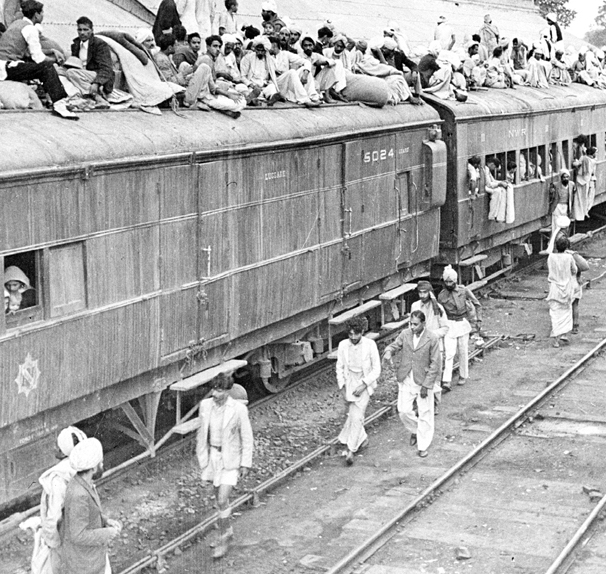
Meanwhile, the news of the partition of Bengal spread like wildfire. Communal riots broke out in Noakhali. Hindus were forced to abandon their homes and hopes of a free nation. Farmlands were burnt, men and women tortured and killed. Their cries shook the heavens.
”Ma, will Mishima come with us?” Munni asked as she packed stuff into her vibrant trunk.
Her mother, who had been hurriedly pushing bare necessities into another trunk shook her head without looking at Munni.
The train coming from West Bengal chugged into the station. Its wooden carriages were plastered with mud and red dust. It groaned with disbelief at the mass exodus. People clung to the window rails, their knuckles white. Men trampled their own brethren. A few Bhadralok contemplated returning back to their mansions, but fate pushed them in.
******
I clung to my mother, Mishima, who nervously tapped our tattered sack, her eyes searching for Munni. A stab of jealousy tore through my chest, not for the first time. Every time I went with her to the Chatterjee mansion, I felt the same.But I went, for the silken threads of Munni’s love tugged at my heart. As we grew older, her kohl- rimmed shy eyes affirmed my love. We met secretly in the paddy fields on full moon nights, the dark shadow of disparities melting in timeless love.
I saw her being pulled into a faraway carriage. Even in the most distressing circumstances, she looked beautiful in the blue Dhakai saree.
“MISHIMA! BHANU!”
Her cries cut through my thoughts. I saw my mother running towards her. I followed her blindly.
Her father peeped his head out. His eyes sparked a warning that made us freeze on our tracks.
“ Munni! No Chottolok with us.” were the last words I heard.
As the whistle blew, the cries on the platform grew louder and smoke denser. I saw her trunk fall on the platform as the blue saree disappeared from our view.
She had gone.
Conflict, like love, knew no discrimination. But humans could decide otherwise.
My mother wiped her tears with her torn pallu. Her hands were calloused from clearing their waste and tilling their gardens. Yet the zamindars had packed their gold and left to build a new life without them.
If only they had left Munni behind.
Mishima looked at my eyes clouded with despair. I realised that she had known the futility of our love all along.
As I approached Munni’s trunk, I touched the dented edge, then saw the lock tied safety with an end of her blue saree.
I caressed the frail threads. They were tied securely, intentionally .
Munni had left memories for me that transcended casteism and racial boundaries.
Maybe she would come back to make some more when parrots could no longer be kept in golden cages.
********
Glossary:
Bhadralok- High- caste Bengalis, ideally zamindars.
Chottolok- Dalits who worked for the High caste Bengalis.
Rabindro Sangeet- Music inspired by Rabindranath Tagore’s works.
Dhakai- A material used in sarees of Bengal.
Punkhas- Cloth, generally white , ceiling fans used particularly in large, opulent houses long ago.
Ma and Dadu- Mother and father or grandfather in Bengali.